Home : Train Tickets :  Rail CompaniesTrain Timetables : Useful Information Travel & Holidays : Contacts  
Rail Saver finds the most cost effective train fares for your rail journey quickly - enjoy more rail travel for less.


Book Virgin Train Tickets
online using the Rail Easy™ train ticket price check and Rail Saver online reservation system to find the cheapest available Virgin Train ticket price on your selected route at your preferred travel times on the National Rail network.

Railsaver Train TicketsRail Easy   Virgin Trains

Virgin Trains CrossCountry operates routes radiating from Birmingham serving all major towns and cities from Aberdeen to Penzance and Glasgow to Brighton.

London Euston is the gateway to the 401 mile-long West Coast Main Line, with services to Birmingham, Liverpool, Manchester, Preston, North Wales and Glasgow.

The longest journey operated by Virgin Trains is the 704 miles covered by trains from Penzance to Dundee, which is also the longest direct train journey in Great Britain.

Virgin Trains run at least six trains per hour in and out of London’s Euston station. This is noticeably busier than GNER in and out of Kings Cross, who operate three or four per hour, and busier than Midland Mainline, who operate four or five trains per hour in/out of St Pancras International.

Using the RailEasy™ train ticket price checker and Rail Saver reservation service to complete an online Virgin Trains train ticket reservation is quick and easy.

Rail Saver will find you the cheapest available Virgin Trains train ticket price and book your Virgin train tickets in a few quick easy steps using the Rail Easy™ price check and Rail Saver booking engine.


More About Virgin Trains

Virgin Trains

In 1996 Virgin Trains won the CrossCountry and West Coast franchises and, the following year, the famous Virgin flair hit the railways. A truly national network, Virgin Trains covers vast areas of Britain.

London Euston is the gateway to the 401 mile-long West Coast Main Line, with services to Birmingham, Liverpool, Manchester, Preston, North Wales and Glasgow.

Virgin CrossCountry operates a complex network of routes radiating from Birmingham, and serving all major towns and cities from Aberdeen to Penzance and Glasgow to Brighton. Over 20 million customers were carried on Virgin CrossCountry in 2005, up from 10.4 million in 1994. The longest journey is the 704 miles covered by trains from Penzance to Dundee, which is also the longest direct train journey in Great Britain.

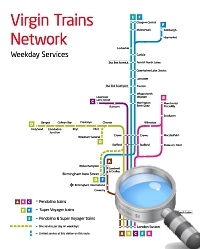
Virgin Trains Rail Route Network

Virgin Trains Timetables

Virgin Trains run at least six trains per hour in and out of London’s Euston station. This is noticeably busier than GNER in and out of Kings Cross, who operate three or four per hour, and busier than Midland Mainline, who operate four or five trains per hour in/out of St Pancras International.

Main Line Route(s):

  • London - North West England - Scotland
  • London - West Midlands
  • South West England - North East England - Scotland via Birmingham
  • London - Manchester / Liverpool
  • Cardiff and Newport - North East England - Scotland

Other route(s):

  • London-Crewe-Holyhead
Primary Routes:-
The Virgin Trains network is split into two divisions namely Virgin Trains West Coast Mainline and Virgin Trains Crosscountry.

Virgin Trains West Coast Main Line Service Patterns

Virgin West Coast Trains

Virgin Trains now run nine trains per day, each way, between Euston and Glasgow Central. The pattern is generally every two hours but there are now some hourly intervals and Virgin Trains intend to ‘fill in the gaps’ in time.

The service compares favourably with GNER’s rival service from Kings Cross for both journey time and frequency. Typical journey times are just over five hours, but there are a couple of reduced stop express services - most notably the 1029 out of Euston which calls just at Preston and Carlisle and takes 4 hours 25 minutes.

The 0949 out of Glasgow is the southbound equivalent. Virgin Trains is ‘testing the water’ with a daily Euston to Edinburgh service. This does not compare at all favourably with GNER’s service from Kings Cross, which is far faster and much more frequent.

North Wales: The line from Crewe to Holyhead — via Chester, Rhyl, Colwyn Bay, Llandudno Junction and Bangor — is not electrified, so services are mostly in the hands of Class 221 Super Voyager diesel-electric multiple units.

One train a day between Euston and Holyhead is worked by a Pendolino, which is pulled by a Class 57 diesel locomotive over the Crewe - Holyhead sector. There are five trains per day in each direction between Euston, Chester and North Wales - four serving Holyhead and one serving Llandudno.

Due to the continuing works in quadrupling the Trent Valley section of the WCML, all Pendolino services north of Stafford are being routed via Birmingham New Street at weekends. This has an adverse effect on journey times - the Euston-Glasgow Central run for instance being pushed way over the 5hrs 30min mark.

Virging Trains Cross Country Service Patterns

Virgin Cross Country Trains

Virgin CrossCountry has easily the most extensive network of any franchise on the British railway system — stretching from as far north as Aberdeen to as far southeast as Brighton and as far southwest as Penzance. The hub of the network is Birmingham New Street. Apart from the Manchester – Glasgow/Edinburgh service and some early morning/late evening services at the extremities of the network, all services serve Birmingham.

Services are operated using Class 220 and Class 221 Voyager DEMUs, which are based at Central Rivers depot near Burton upon Trent, Staffordshire. However, Voyager units have been encountering serious technical problems as of late 2005/early 2006 and as a result other traction has been 'hired in'. Midland Mainline HST diesel units have been used on the Leeds/Newcastle – Plymouth sector whilst Class 90 electric locomotives, with Mk 2 coaches and Driving Van Trailers have been used on Birmingham – Manchester services.

There are four principal corridors radiating from Birmingham New Street, each with a half hourly service pattern. These are south eastwards to Reading, south westwards to Bristol, north westwards to Manchester and north eastwards to Derby and Sheffield. There is also an hourly pattern over the Birmingham – Preston – Scotland sector via the West Coast Main Line.

Apart from early or late in the day, most services do not start or terminate at Birmingham but operate as through services (e.g. Manchester – Brighton, Glasgow – Penzance). The southerly terminating points are Reading, Brighton, Southampton, Bournemouth, Penzance, Plymouth and Cardiff.

The northerly terminating points are Aberdeen, Dundee, Glasgow, Edinburgh, Newcastle and Manchester. The Manchester – Scotland service, via Carlisle, sees a two hourly pattern with four trains per day Manchester – Edinburgh and three per day Manchester – Glasgow. This is in the next few years to transfer to TransPennine Express. This will release the Voyager units for Holyhead workings. Glasgow will only be served by CrossCountry services via Edinburgh and the East Coast Main Line from 2007.

Stations on the West Coast Mainline between Warrington Bank Quay and Lockerbie (inclusive) will lose all their Cross Country services, which will be replaced by a new service terminating at Birmingham New Street, operated by Virgin West Coast.

Virgin Trains Current Network Rolling Stock

Virgin Trains Rolling Stock

The table below lists the rolling stock used by Virgin Trains on their primary rail routes.

Code Route Rollingstock
VT1 through to the and Voyager
VT2 South coast through to the and Voyager
VT3 and through to the and Voyager
VT4 along the coast Voyager/Pendolino
VT5 to and Pendolino
VT6 to the / into Pendolino
VT7 to via or Pendolino
VT8 to Pendolino
Virgin Trains Into The Future

Virgin Trains Route Network

Virgin Trains lost the right to operate the major part of their franchise in July 2007 which will be now be operated by Arriva from November 2007. Some services will totally cease (Scotland to south of Birmingham via the WCML), whilst others are to be transferred to Virgin West Coast in December 2007 (Glasgow/Edinburgh to Birmingham).

The existing Cross-Country franchise will finish in November 2007 and Virgin will not be operating the new franchise. It was announced on 10 July 2007 by the Department for Transport (DfT) that Arriva will be operating the new network from 11 November 2007, which will include a number of former Central Citylink services following a reshuffle of franchises in the Midlands. Virgin immediately announced their disappointment and said they were seeking a meeting at the earliest opportunity to find out why they were not re-awarded the new tender. The loss of the Cross-Country franchise will see a realignment of Virgin Trains' rolling stock; all 34 of Virgin's Class 220 Voyager and 23 of 44 Class 221 Super Voyager DEMUs will remain on the Cross-Country routes with the new operator CrossCountry. The remaining 21 Class 221 units will be transferred to Virgin West Coast for use on the North Wales Coast Line.

Projected growth in passenger numbers on the West Coast routes has prompted discussions about increasing the length of Pendolino sets to 11 or (more likely) 10 vehicles. The likelihood of 10 car formations was foreseen in the original WCML strategy, so minimal infrastructure improvements would be required. A decision was expected from DfT by the end of 2006. This has been put in jeopardy recently as a result of an enquiry into the leasing of trains being carried out by the Competition Commission. It is likely that plans will delay the improvements until 2011/2012.

Following the completion of the Trent Valley Line quadrupling and Rugby junction upgrades to allow 125mph running (completed by 2008), West Coast journey times are expected to fall further; Glasgow-Euston 4hr 15mins, Euston-Birmingham 1hr 20mins. Virgin claim that 135mph running may be possible in places, although Network Rail remain sceptical - stating that significant signalling upgrades would be required.

Virgin have consistently expressed an interest in the InterCity East Coast franchise since privatisation. However, it failed in its bid in 2005 to gain control of the route from incumbent GNER. On 15 December 2006, the DfT announced its wishes for GNER to 'surrender' the East Coast franchise, following financial and operational problems at its parent company, Sea Containers. This caused a re-start of the bidding process in which the DfT stated that GNER was welcome to re-bid for the franchise, an opportunity which they did not take up. However in a curious twist the GNER board later announced they would join the bid submitted Virgin and Stagecoach Group which has been shortlisted under the name "Intercity Railways". On Tuesday 14 August 2007, Department for Transport announced that National Express East Coast (NXEC Trains Ltd) had won the franchise .

An open-access operator, Wrexham & Shropshire, has submitted a plan to operate services between London and North Wales, which would involve utilising a stretch of the WCML. Virgin Trains objected to this proposal, which would have seen Wrexham & Shropshire having trains call at Wolverhampton. Due to the moderation of competition protection that is part of Virgin's West Coast franchise agreement, Wrexham & Shropshire have had to submit a new proposal that will involve only limited use of Wolverhampton, with Tame Bridge Parkway railway station used as its main Midlands stop. Wrexham & Shropshire are due to begin their operations in spring 2008.

On June 7, 2007, Richard Branson and Gordon Brown launched Europe's first bio-diesel train for a scheduled 11:27 London Euston - Llandudno service.

Rail Saver finds the most cost effective Virgin Train fares for your rail journey quickly and easilly. Enjoy more rail travel for less when you use Rail Saver to book your Virgin Train tickets online. For more information on Virgin Trains please click here.