Home : Train Tickets : Rail Companies : Train Timetables : Useful Information : Travel & Holidays : Contacts |
|||||||||||||||||||||||||||||||||||||||||||||||||||||||||
More About Southeastern Railway
Southeastern Railway is owned by Govia, which is itself jointly owned by Go-Ahead Group and Keolis, who also operate the neighbouring Southern operating company which overlaps with Southeastern in some areas. The company’s formal name, under which it mounted its bid for the franchise, is London and South Eastern Railway and it runs train services in Kent, South east London and part of East Sussex.
Following the completion of the Channel Tunnel Rail Link (also known as "High-Speed 1" or HS1), Southeastern will operate high-speed domestic services on it, including the Olympic Javelin service that is to run during London's 2012 Summer Olympics. Southeastern Railway Train Network
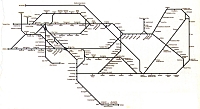
Southeastern Ralway Main Lines The Southeastern Railway mainline routes all depart from London termini (Victoria, London Bridge, Waterloo East, Charing Cross, Blackfriars, and Cannon Street). The main line routes followed are:-
Southeastern Railway Suburban Lines
The suburban services operated by Southeastern run to:
Southeastern Railway Rural Lines
Southeastern operate a limited rural service on the following routes:-
Southeastern Railway Route Enhancements
Following the completion of the high speed channel tunnel line in November 2007 the following service engancments were introduced by Southeastern Railway:-
Southeastern Railway Future Expansion
Following the completion of the high speed Channel Tunnel Rail Link Southeastern will operate high-speed domestic services, including the Olympic Javelin service during London's 2012 Summer Olympics, on it. High-speed domestic services are expected to begin in December 2009 and the first four trains are to be delivered in 2007 for testing and driver training. A fleet of twenty-nine six-carriage Shinkansen-derived high-speed ‘A-trains’ have already been ordered from Hitachi for this route. They will be known as Class 395 when in service. The first train will be named after Dame Kelly Holmes, a British gold-medal athlete, with further trains to be named after British personalities associated with speed. The colour scheme for the high speed trains will be dark blue - using the same corporate colour as their logo. Current plans call for the company to operate up to ten high-speed trains per hour at peak times, with four trains per hour off-peak. These trains will only run at high speed on the CTRL itself and at some point each will switch over to conventional track and need to run at reduced speeds alongside conventional trains.
Southeastern sell a variety of tickets for their trains. These and certain of the relevant ticket restrictions are detailed in the table below. All these tickets may be purchased online using the Train Conducor's online reservation service at the top of this page.
Southeastern operates one of the busiest rail networks in the country, and during peak periods, many services are crowded with some passengers obliged to stand. On these peak services cycles take up space needed by passengers and are therefor not permitted on peak time services arriving in London from Monday to Friday between 07.00 and 09.59, and leaving London between 16.00 and 18.59. If you are starting your journey from one of the following boundary stations, and heading away from London, you are permitted to take your cycle at any time. These stations are Gillingham, Otford, Tonbridge and Redhill. Similarly, if your journey starts in Kent or east Sussex and terminates anywhere before these stations, you are also permitted to take your cycle, subject to onboard space. Folding cycles may be carried on board any train, provided they are folded before being taken onto the platform and remain folded on the train during the journey. Southeastern Railway History
Southeastern Railway was a wholly owned subsidiary of the Strategic Rail Authority (SRA) until franchise was re-privatised on 1 April 2006. It assumed the services following the withdrawal of Connex South Eastern’s franchise on 9 November 2003. Part of the company’s public information leaflet at the time stated that SET ‘will operate the franchise until a private company is appointed to manage the new Integrated Kent Franchise (IKF)’. Some trade unions, such as the RMT, opposed the plans to re-privatise (April 2004), and campaigned for SET to continue under public ownership. Train fares, staff and schedules remained the same. In the ensuing 18 months the company announced staffing changes involving station staffs, but pointed out that 400 more staff were employed: 90 new jobs involved in station security and ‘revenue protection’ were created. Press articles claimed that large-scale cuts in services would be undertaken; in response to strenuous opposition by local councils, these were modified to some extent been, although some fears remained about the services in the Thames Gateway area. Two stations are to close, although services on the Sheerness branch line from the Isle of Sheppey, which currently terminate at Sittingbourne, are to be extended to Dover. The routes across Kent are a legacy of the conflict between the London, Chatham and Dover Railway and South Eastern Railway, leaving several towns with more than one railway station. The two companies effectively merged in 1899 into the South Eastern and Chatham Railway. This allowed some rationalisation (eg in Thanet, Sevenoaks, Ashford and Rochester) but this was never completed leaving a legacy of competing / unconnected routes (eg Gravesend, Canterbury, Whitstable, and Maidstone). Upon grouping in 1923, the SECR was incorporated into the Southern Railway. Around half the network was electrified at 750v DC third rail by World War Two (London to; Gillingham, Maidstone East, Maidstone West and Sevenoaks). The rest of the network was electrified under British Rail’s 1955 modernisation plan. Freight only lines and the Marshlink line were not electrified (Marshlink is now operated by Southern). Under privatisation in 1996 the franchise was awarded to Connex as Connex South Eastern but the Strategic Rail Authority (SRA) stripped them of franchise in June 2003 citing ‘poor financial management’, setting up the SRA-owned South Eastern Trains. During this period the very large fleet of Mk1 Slam door stock was replaced by modern Electrostar sets. This required significant power upgrades. At the same time with the construction of the Channel Tunnel, and the gap between the complete opening of the Channel Tunnel Rail Link, meant significant power upgrades were required over two main lines to allow Eurostars to access Waterloo and the reopening of the section Gravesend Branch Line. As of 1 April 2006, the SET franchise has been transferred to Govia, who operate it under the name Southeastern Railway. Rail Saver finds the most cost effective SouthEastern Railways Train fares for your rail journey quickly and easilly. Enjoy more rail travel for less when you use Rail Saver to book your South Eastern Train tickets online. |
|||||||||||||||||||||||||||||||||||||||||||||||||||||||||